Showing posts with label travel. Show all posts

Monday, August 24, 2009

The Grand Palace


The Grand Palace (พระบรมมหาราชวัง) adjoins Wat Phra Kaew in a common compound, and is where you will end up after exiting Wat Phra Kaew. Despite the proximity of the two, there's a distinct contrast in style between the very Thai Wat Phra Kaew and the more European inspired designs of the Grand Palace (the roof being the exception). The Grand Palace is nowadays used only for occasional ceremonial purposes and is no longer the royal residence. The present King Bhumibol (Rama IX) lives in Chitralada Palace (also closed to tourists), which is located not too far away in Bangkok's Dusit district. Though the interior of most of the buildings remain closed to the public


Highlights of it are:

- Boromabiman Hall, built by King Rama VI and every king since has lived here at some time.


- Amarinda Hall, the original residence of King Rama I and the Hall of Justice. Nowadays it's impressive interior is used for ceremonial occasions and coronations. It contains the antique throne, used before the Western style one presently in use.


- Grand Palace Hall / Chakri Maha Prasat. Visitors are allowed inside the spacious European style reception room. This building has not been used for royal residence since the mysterious death of King Rama VIII (the older brother of the current King), found shot dead in his room in 1946. The reverence for the monarchy in Thailand means that, even today, this remains a completely taboo subject to talk publicly about in Thailand.


- The impressive Dusit Hall, rated as perhaps the finest architectural building in this style.


- The Museum, which has information on the restoration of the Grand Palace, scale models of the Wat and Palace and numerous Buddha images. Labels are in Thai only, but there are free English tours available frequently. Entrance is 50B.

Details

The combined compound is open 8.30am to 3.30pm everyday. Cost is 200B (if you are Thai, it's free), and includes admission to Vimanmek Mansion and Abhisek Dusit Throne Hall, both in the Dusit area of the city, the Coin Museum in the compound, and so-so free guidebook. The entrance to the compound is on Na Phra Lan road, on the north side.

Don't listen to anyone on the street as you try to enter telling you it's closed for a 'Buddhist holiday', 'cleaning' etc, or asking if you want to see the 'Lucky Buddha' instead - it's all part of a sophisticated gem scam.

As Wat Phra Kaew is Thailand's most important temple, you are expected to dress appropriately or risk being turned away. Signs put up around the entrance show you are not permitted to enter wearing shorts, sleeveless shirts, singlets or any form of open ended shoes. Sarongs and long trousers are usually available for loan should you forget.

Other attractions easy to reach from here are Wat Pho, Wat Arun, the National Museum, others sights in the Ko Rattanakosin area, and the Banglamphu district.

There's plenty of options for getting to the Grand Palace and Wat Phra Kaew. Ordinary buses 44, 47 and 91 stop on Thaiwang road between Wat Pho and Wat Phra Kaew. Ordinary buses 1, 25, 44, 47, 82 and 91 also stop on Maharat road, on the west of Wat Phra Kaew. On nearby Sanam Luang, north of Wat Phra Kaew, ordinary buses 3, 15, 30, 32, 43, 44, 59, 64, 70, 80, 123 and 201 all stop, as well as aircon 6, 7, 12, 39 and 44. The Tha Chang river express boat stop is also very near. If you're staying in Banglamphu, it's possible to walk there via Sanam Luang. It's only about a 1 km walk, but involves crossing some large and busy roads which don't have any obvious crossing places.


http://www.into-asia.com/bangkok/attractions/grandpalace.php

Wat Phra Kaew, Temple of the Emerald Buddha


Wat Phra Kaew (วัดพระแก้ว), the Temple of the Emerald Buddha, and the adjoining Grand Palace together form perhaps the greatest spectacle for the visitor to Bangkok. Despite the fact that the whole compound is so full of tourists you spend half the time trying to avoid getting in people's photos, it's still a pretty amazing place to visit. It consists of over 100 brightly colored buildings, golden spires and glittering mosaics, and dates back to 1782, when Bangkok was founded. When you enter the compound, you first of all see Wat Phra Kaew and the nearby attractions, and then move on to the Grand Palace afterwards. Wat Phra Kaew itself, generally known to the Thais as Wat Phra Si Rattana Satsadaram, is perhaps the main attraction. This is Thailand's most important and sacred temple, so you're expected to act with due respect inside it. It houses the tiny (between 60 and 75 cm) Emerald Buddha, which is located high above the heads of the worshippers and tourists. Not much is known for certain about the statue, except that it isn't actually made of emerald but rather of green jade or jasper. Getting a good look at it is difficult as photography is forbidden inside the temple, and it's perched so high up inside it's glass box that it's difficult to really see.


It's thought to have been made in the 15th century and was the cause of several wars before ending up for good in Bangkok in 1782. The image is considered a talisman and holds tremendous significance for Thailand and the Thais. The 'robe' that it wears is changed 3 times each year by the King himself, at the start of each season: A diamond encrusted gold robe during the hot season, a solid gold robe in the cool season and a gilded monk's robe in the rainy season.There are also many other Buddha images inside the temple.

Round the interior walls are murals depicting the jataka stories. These are located according to the typical Thai conventions inside temples. The ones facing the altar depict the victory of the Buddha over the evil demon Mara, as he subdues her and achieves enlightenment. As is normal for Thai temples, shoes must be taken off before entering into the temple.


Despite it's national importance, Wat Phra Kaew is the only temple in Thailand that doesn't have any resident monks, and so is not a seat of Buddhist learning in the same way as the likes of Wat Pho and Wat Mahathat.

A cloister surrounds the temple, and depicted along here is an extensive mural of the Ramakian, the Thai version of the famous Indian epic, the Ramayana. In total there are 178 sections, and although they date from the reign of King Mongkut (Rama IV 1825-1850) they have since been restored on numerous occasions. The explanatory texts across from each were devised by King Chulalongkorn (Rama V).

Also in the compound is:

- A miniature model of the famous Cambodian temple complex Angkor Wat, made during the reign of King Mongkut (Rama IV) when the Thai empire extended over Cambodia.

- Two libraries, built to protect copies of important Buddhist literature. The Phra Mondop library is impressive, but almost always closed to the public. If not, it's well worth looking at.

- The impressive golden Phra Si Rattana Chedi, which it's claimed (somewhat improbably) houses ashes of the Buddha.

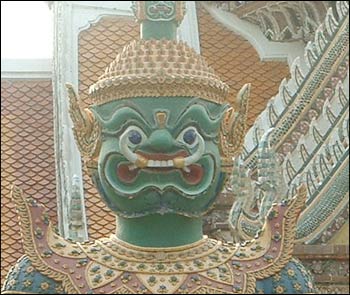
- The Royal Pantheon, with full size statues of the first seven kings of the reigning Chakri dynasty (Rama I - Rama VII). Only open on April 6th, the anniversary of the founding of this dynasty. Surrounding this are large statues of mythical guardians (pictured right), such as the kinaree, half human-half bird and the Hindu garuda bird. It contains the scared Buddhist scriptures, the Tripitaka.


http://www.into-asia.com/bangkok/attractions/watphrakaew.php